
3 July, 2026 · 10 min read

The structural drivers that will see the industrial & logistics market through uncertain times

Share:

read in PDF format

This paper explores the tension in UK industrial & logistics real estate between short-term capital market disruption and strengthening long-term fundamentals. The Iran War and the closure of the Strait of Hormuz have intensified trends on both sides of this equation, adding to short-term uncertainties while strengthening some of the structural drivers behind the sector.

Short-term disruption, not demand collapse:

The Iran energy shock has reset expectations for yield compression. This will stall transactions through a reset of price discovery, rather than a deterioration in occupier fundamentals.

Demand drivers are long-term, structural and have been intensified by the war:

  • Larger inventories: Supply chain vulnerabilities have been brought into even greater focus by ‘choke points’ such as Hormuz. This is likely to reinforce the shift to larger inventories (‘just in case’) and commensurate demand for industrial space.
  • Defence Spending: The Iran and Ukraine wars have highlighted both increasing global instability and the weakness of some aspects of UK defence. The UK’s Defence Investment Plan, published at the end of June, lays out £298bn of spending over the next four years, with the aim of it reaching 2.7% of GDP by 2030. With the emphasis on new autonomous and drone technologies, as well as new air defence systems, “this will generate additional demand for industrial & logistics space, with second-order effects on the wider supply chain.
  • Energy Security: The demand for battery storage – which is becoming cheaper and increasingly practical at scale – will increase demand for industrial sites and crowd out traditional uses.
  • Tech Spending and Hyperscaling: The investment by major tech players in data centres looks set to continue, despite concerns over sustainability – providing a further source of demand and competition for B2/B8 uses

But supply will be cyclically constrained for the foreseeable future: Rents remain robust, reflecting a shortage of modern, fit for purpose space despite elevated headline vacancy, as much of this empty stock is functionally obsolete. These shortages will intensify over the next 2-3 years as development has slowed sharply due to elevated cost and uncertainty and there is little sign of it picking up in the near term. This will favour developers and investors able to deliver into this market.

Strong relative positioning in a higher-rate world: Even if higher rates persist as a “new normal,” industrial & logistics is the best placed broad commercial property sector to weather it, given the combination of constrained supply and structurally driven demand.

PROPERTY MARKET IMPACT

Back at the start of 2026, investment in UK industrial & logistics property – as with the wider market – was showing some signs of improvement.

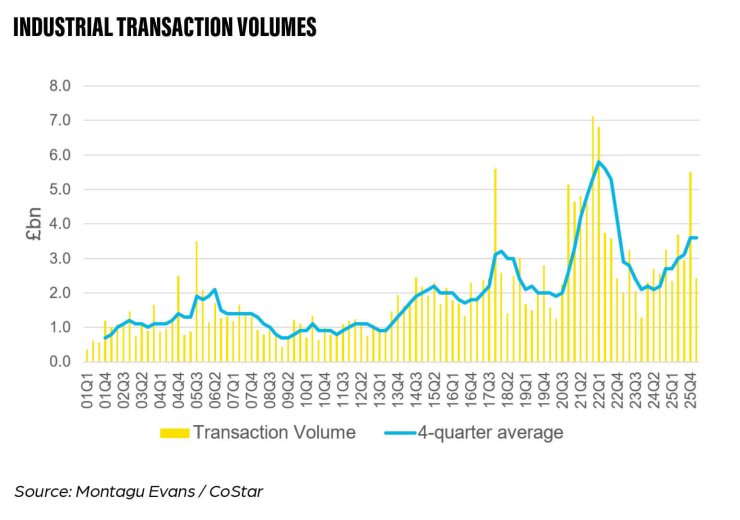
The £5.2bn transacted in Q4 was the highest quarterly total since Q1 2022, while the £13.7bn recorded for the year as a whole was a three-year record.

This was partly driven by the expectation that base rates, debt costs and risk-free rates would continue falling. The prices expected by vendors were, against this backdrop, starting to make more sense to buyers.

There had also been signs of a modest improvement in occupier markets, with vacancy edging down from a recent high and net absorption heading out of negative territory.
The events of February and March fundamentally reset expectations. The US’s “Operation Epic Fury” (the attack on Iran) and the subsequent double-blockade of the Strait of Hormuz have forced a revision of inflation and interest rate forecasts. The impact of these events will reverberate across markets for months even if the agreement reached at the time of writing holds.

Clearly, higher energy costs alone will force up inflation. But the risk is that there are second-order effects resulting from the impact on businesses, who will be forced to pass on higher input or transport costs to consumers. Struggling consumers may also increasingly demand higher wages, leading to a price-wage spiral and a further spike in inflation.

Although this looks unlikely given the increasing slackness in the labour market, the Bank of England is now expected to keep rates flat in 2026, compared to the 50bps cut expected just a few months ago. What’s more, the risks are skewed towards rate hikes despite the job market weakness. The Bank will be keen to avoid a repeat of the post-Covid situation, when it was criticised for not acting quickly enough.

Bond yields have moved higher globally; the UK appears to have been particularly badly hit, driven by all the above factors plus the ongoing political uncertainty in the Labour Government.

This all means that prices agreed in January or February no longer made sense against the backdrop of higher debt costs or risk-free rates. The momentum in the market was based on the assumption that yield compression was likely over the next couple of years, pushing prices higher.

Unsurprisingly, even though it contained only one month of post-Iran activity, the Q1 figure was less than half of the previous quarter, at £2.4bn – although this was still the highest Q1 total since 2022.

Market shifts are likely to suppress transactions for at least another two quarters against the background of a temporary absence of price discovery, reflecting a divergence between robust prospects and weaker capital market conditions. The exact duration depends on how long the crisis persists, and the exact nature of the impact of the energy shock on the economy. Ultimately, it remains to be seen whether this will have durable effects on the real economy beyond a temporary interruption, or whether it is a temporary supply shock that will lead to a ‘bump’ in rates, which return quickly to the January rates once the situation normalises.

Our base case is the latter, leading to a pause in investment activity followed by a recovery in late 2026 or early 2027, with occupier demand continuing to improve gradually against a constrained supply backdrop.

Recent events, such as a tentative deal being reached to reopen the strait, and UK inflation for May coming in below expectations, have provided support for this scenario. On the other hand, there is every possibility that instability could return, given the distrust between the various parties.

In the longer term, the increase in oil production away from the Gulf, and moves such as the UAE’s exit from OPEC, could lead to an energy glut that would force inflation below pre-conflict forecasts. This needs to be set against the fact that Iran has demonstrated its ability to close the Strait of Hormuz, adding a new risk premium to energy markets.

At present, there are some indications – not least the strong Q1 GDP outturn and resilient PMI readings, including for manufacturing – that the UK economy is performing better than feared. However, there is a lag in terms of the impact on the consumer, and the real effects may not be evident until late Summer.

And in terms of the sector specifics, inflation could have some major direct impacts on occupiers. They will be hit by higher energy and other input costs, coming on top of recent increases in rents and business rates. And secondly, retailers – who benefited from the buoyant sales figures around the beginning of the year – may come under more pressure as consumers tighten their belts. This could clearly impact on retailers’ propensity to take logistics space.

On the other hand, rents have remained robust, a reflection of the emphasis upon modern units among occupiers and a shortage of good quality newly developed stock. The ongoing dearth in development will only intensify this imbalance over time (see below).

This is a nationwide picture, but there has been real geographic variation in leasing markets, with the North West (and to a lesser extent the West Midlands) relatively active. London has been somewhat quieter, although recently hotspots have emerged in Heathrow and Canning Town. Rental affordability, supply, and local economic dynamics are all important factors.

Notwithstanding these nuances, the industrial & logistics market looks set for a slowdown after a false start in late 2025. Yet it remains highly favoured among investors, judging by the appetite laid out in their strategy documents.

This is partly a result of the mantra of ‘beds and sheds’ that has become received wisdom globally among property investors. This demand has been bolstered by this herd effect, which in turn has kept industrial the best-performing sector, further supporting investment cases. (Central London offices have lost out from the opposite effect).

But there is also a logic behind this, especially if you are operating over a 5-year investment horizon. The cyclical weaknesses outlined above sit alongside a set of structural demand drivers that have, if anything, been reinforced by recent geopolitical events.

Demand: Structural Trends

01) SUPPPLY CHAIN VULERABILITIES AND ‘JUST IN CASE’ IVENTORIES

Many companies – whether manufacturers, distributors or retailers – have moved away from ‘just in time’ logistics to ‘just in case’. Greater geopolitical instability has led to efforts to maintain larger inventories of supplies as an insurance policy, alongside sourcing more locally if possible.

The blockade of the Strait of Hormuz has intensified this concern. There is now a new focus on the world’s ‘choke points’ – the likes of Panama, Suez, Bab-al-Mandab and the Strait of Malacca. Military action in any of these waterways could freeze the supplies of many important materials.

The logical response is to focus even more on larger inventories and ‘nearshoring’ supply chains. Even if local providers themselves are dependent on global supplies, they too will be taking similar measures, further shock-proofing their operations.

From the point of view of the industrial & logistics property market, this implies that the demand for modern logistics space will increase substantially over the next few years – all that additional inventory will require storage facilities.

The demand may be more geographically spread out than in the past as there has been a move away from a ‘hub-and-spoke’ distribution network (with the hub in the ‘golden triangle’) towards a more distributed model better suited to home delivery and rapid response times.

02) THE IMPACT OF DEFENSE SPENDING

The Iran War, following on from Russia’s invasion of Ukraine, has demonstrated that the world is becoming more unstable. This has added new urgency to the UK’s ambition to increase defence spending to 2.7% of GDP by the end of the decade and 3.5% by 2035.

The Defence Investment Plan, published at the end of June 2026, lays out £298bn of investment over the four years to 2030. The emphasis is upon emerging technologies such as uncrewed systems and drones, new air and missile defence systems and cyber and electromagnetic domains.

The document also states that 60,000 new jobs will be created, with investment in skills. In last year’s Modern Industrial Strategy, defence was identified as one of the IS-8 sectors with an aspiration to become Europe’s leading exporter in the sector.

This increase in spending both domestically and within the EU is likely to have spill-over impacts on other sectors as well as the industrial property market. Scaling up defence R&D and manufacturing will require investment in new facilities and storage units, adding further to the demand for space in the sector. There are additional potential spin-off benefits for supply chains, which extend beyond defence specialists. Many technological innovations began in military research, after all.

Many other countries – such as Poland and Germany – have increased spending more rapidly. This, too, could have implications for UK industries given the importance of cross-continent collaboration and the UK’s abilities in some areas of defence.

Defence spending is spread across the UK, but is somewhat skewed to the South East, South West and the North West, and there will be some concentration of benefits in these areas. While it will not be a dominant national driver, it will add to the demand for industrial space and land across the country.

03) ENERGY SECURITY, RENEWABLES AND BATTERY STORAGE

The energy shock created by the Iran War has placed a new emphasis on energy resilience and independence. This is likely to accelerate the move towards more renewables on and around industrial and logistics facilities.

While the debate over North Sea oil and gas has dominated the headlines, the increase in renewables deployment will continue regardless. But more important for the industrial market will be the steps taken to avoid the intermittency issue – what happens on a still, cloudy day.

Battery storage is likely to be a central part of the solution. Costs are falling rapidly. According to Bloomberg NEF’s Energy Storage Systems Cost Survey 2025, the cost of a turnkey battery storage system fell by 40% in 2024 and 31% in 2025, with similar figures expected for the next few years.

The potential arrival of sodium-ion cells could see prices fall even more quickly. Not only is Sodium hugely cheaper and more widely available than Lithium, but it is also better suited for mass grid storage, with lower fire risk and better cold-weather performance. This could accelerate the economic viability of mass battery storage over the next decade.

This is likely to increase demand for power-connected industrial sites and suitable industrial units that can host these installations. It will also focus minds on how to increase local generation and storage, with an even greater emphasis on how to use roofs and other surfaces for solar panels – all part of a wider emphasis on energy resilience.

Not only will this add to existing demand, but it will also remove some key sites from the market for more conventional industrial and logistics activities. National Grid estimates that a further 21GW of storage will be required by 2030. Translating this into space requirements is difficult, as both regulations and technologies are changing and consultancies give varying estimates for the space required for a GW of storage. Applying different figures gives a total of between 1,000 and 20,000 acres. The actual land take is not the important factor however – the key issue is that it provides further competition for “powered sites” in certain locations.

The energy shock is also likely to lead to a greater focus on the shift to electric vehicles within the logistics space. This may change the layout and type of facilities required, as well as directly stimulating automotive supply chains.

04) TECH SPENDING, HYPERSCALING AND DATA CENTRES

The vast and almost unprecedented investment in Artificial Intelligence (“hyperscaling”) is leading to strong demand for data centres. Many larger industrial & logistics facilities can easily be converted to this use. The UK struggles with energy and grid issues, so this is only viable in certain locations, although this is gradually mproving.

The recent investment of many AI firms – such as Anthropic and OpenAI – in new London offices will indirectly increase the demand for suitable data facilities in the surrounding area. The suitability of many industrial sites for data centres, and the higher land values involved, further reduces supply and increases demand. There are legitimate questions over how durable this demand will prove. Detractors point towards both the UK’s energy constraints and fears of a bubble in AI spending.

05) COMPETITIVE RETAIL LOGISTICS

Retailers’ logistics networks have been constantly rethought over the past decade as they have adapted to the demands of e-commerce and home delivery. More recently, the servicing of stores as click and collect points has become more central. This process of reinvention will only accelerate.

This means that their requirements, both geographically and in terms of facility layout, will continue to change for the foreseeable future. This in turn explains the strong preference for new build and an increasing ‘accelerated obsolescence’ in the sector.

will look at changing requirements in a future research paper, but this implies increased demand from retailers, skewed strongly towards new space, and potentially in different locations as ideas around logistics networks shift. This is creating new hotspots in property markets.

Supply: Development Shortages

While these drivers are long-term and structural, the supply side of the equation is weak and looks to deteriorate further as development is at a low ebb.

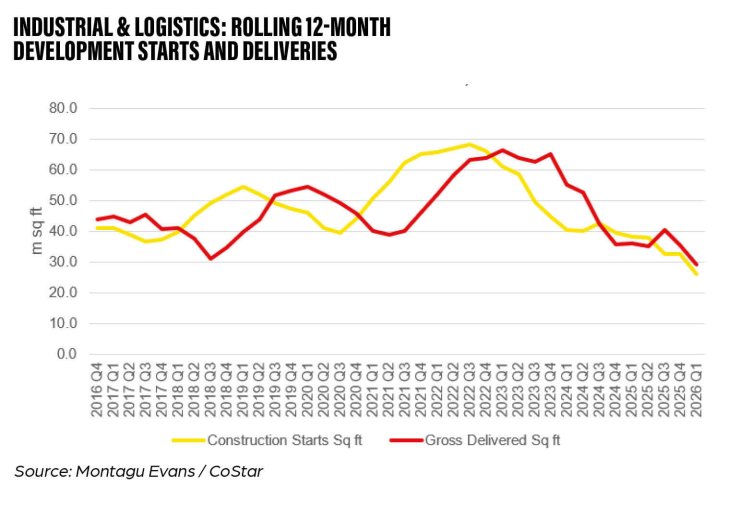
Most UK property sectors have seen a reduction in construction activity since the Ukraine war, driven by higher debt and construction costs pushing down viability. Industrial & logistics have been no exception.

As can be seen below, the amount of space started and completed over the past two years has been steadily falling and is now at its lowest rate for at least a decade. It is not just high and volatile costs that are to blame – uncertainty around planning, exit pricing and short-term occupier demand are delaying decisions.

As vacancy rates are at a cyclical high, it could be argued that this shift is because of a decrease in demand and an increase in availability. However, there is reason to believe that occupier requirements are skewed towards new build, well-specified stock rather than the secondhand space which makes up much of the vacant units. Increasingly, they are competing for a scarce supply of premium product. The main evidence for this is the fact that average rents have been rising nationally – at the same time as vacancy. This would be difficult to explain economically, unless the deals that are happening are skewed towards the best quality new space.

The breakdown of vacancy confirms this. Of all the industrial space currently available in the UK, 75% was built more than three years ago; most of this (71% of the total) was built more than five years ago. Much of this will not meet modern occupier requirements, meaning the vacancy rate is a little misleading. Much of it is functionally obsolete.

The lack of development and this strong preference for new build – which reflects the rapid pace of change in occupier requirements – suggests that there will be genuine shortages over the next few years in the face of the broader demand trends outlined above. This will favour investors and developers who are able to deliver into this market.

Conclusion

The market is currently more subdued than a few years ago. Leasing levels are somewhat lower, and investment in industrial – which is still the largest slice of the market – has dropped from post-pandemic highs. Occupiers are struggling to digest their own energy cost increases, alongside business rate shifts and wider market turbulence.

But while vacancy rates are higher than in the aftermath of the pandemic, they remain lower than in other sectors, and the buoyancy of rents suggests strong demand for the right space. Take-up may have been weaker over the past year or so, but the structural shifts outlined above suggest this will recover more strongly over the coming years.

This will collide with a shortage of new supply. The lack of development outlined above will be compounded by the take-up of space planned or used by industrial & logistics
by competing uses such as battery storage and data centres. This mismatch between supply and demand may not be evident yet, but it will be within 2-3 years, creating more upward pressure on rents.

On the investment side, if the Iran-related inflation shock is temporary, and inflation and risk-free rates return to early-2026 levels, then the downward pressure on yields
will return.

Of course, there are also reasons why rates and yields could remain elevated – a ‘frozen crisis’ in the Gulf, further political turmoil in the UK, or higher inflation than
expected – but the market dynamics suggest that this would at least be partially offset by the return of stronger rental growth.

Developers and investors who can deliver into this market will benefit the most. This will involve identifying sites now for purchase or redevelopment, bringing them through the planning system, or even commencing development.

Ultimately, in this market, the demand drivers are increasingly structural, whereas supply remains cyclical and constrained. Any weakness over the next few months will primarily be driven by financial factors such as rates and yields. In contrast, the long-term strength derives from the real economy, from structural shifts in logistics, energy, tech and supply chains.

So, while there will be ebbs and flows in take-up, pricing and investment volumes, it still has the best relative growth prospects among the major commercial sectors, underpinned by structural drivers of demand and constrained supply.


*This research has been prepared for general information purposes only. It does not constitute any investment, financial or other specialised advice or recommendations, and you should not, therefore, rely on its contents for such purposes. You should seek separate professional advice if required.

Share: