
7 April, 2026 · 9 min read

The Residential Land Survey (2026)

Share:

read in PDF format

London’s residential development market remains severely constrained. Housing starts in 2025 (7,480) are under half the long‑term average and far below London Plan requirements. And while developers have been blaming viability, planning delays and the Building Safety Act, this year’s Montagu Evans London and South East Residential Land Survey shows a decisive shift.

Our survey of 53 developers and investors in London and the South East shows that market demand has now become the primary brake on delivery.

Developers report weak buyer confidence, reduced overseas investment, and affordability pressures. As a result, they’re worried about whether they can sell new homes, not just their ability to build them. This is despite the recent resurgence of institutional capital, which has provided a much-needed lifeline.

Format preferences are also changing. Medium‑rise apartment blocks (up to ~6–8 storeys) are now the clear favourite among developers. This reflects buyer appetite and an attempt to avoid exposure to the safety regulations around high‑rise buildings. Low‑rise family housing has surged in popularity too, even among London specialists. However, land constraints limit its potential within the capital.

The land market is adjusting, with most respondents now seeing slight price declines, indicating a greater pragmatism among landowners. Meanwhile, the MHCLG/GLA emergency measures, aimed at boosting viability and still in draft form at the time, are cautiously welcomed. That said, many think the time limits – now extended – would have prevented them from being effective.

Overall sentiment suggests that the market had started to stabilise before the Iran conflict, with expectations of a gradual recovery. Developers were beginning to look ahead to delivering in supply-constrained markets in 2027 and 2028. However, political unpredictability and the decline of the off‑plan investor market have eroded confidence. Many developers call for renewed demand‑side stimulus (e.g., SDLT holidays or Help to Buy) to help absorb smaller flats.

The survey underlines that London’s housing crisis can no longer be attributed solely to planning, viability, or building safety. Demand‑side weakness, particularly for urban high‑rises, is now an equally important constraint. This will require planning authorities to take account of the market’s pivot towards medium‑rise and family housing.

The findings also strengthen the case for the government’s new towns programme. Many of the sites can deliver the mix of mid‑rise and suburban format favoured by developers and buyers.

London Housing Crisis

Carried out earlier this year, our London and South East Residential Land Survey comes at a time when the capital’s development market is in the spotlight.

According to National Statistics, just 7,480 homes were started last year. This was up from the 6,600 started in 2024, but less than half the 10-year average of 16,000, and a fraction of the London Plan target of around 80,000 per annum. This is a national-scale crisis, given the capital’s importance to the UK economy.

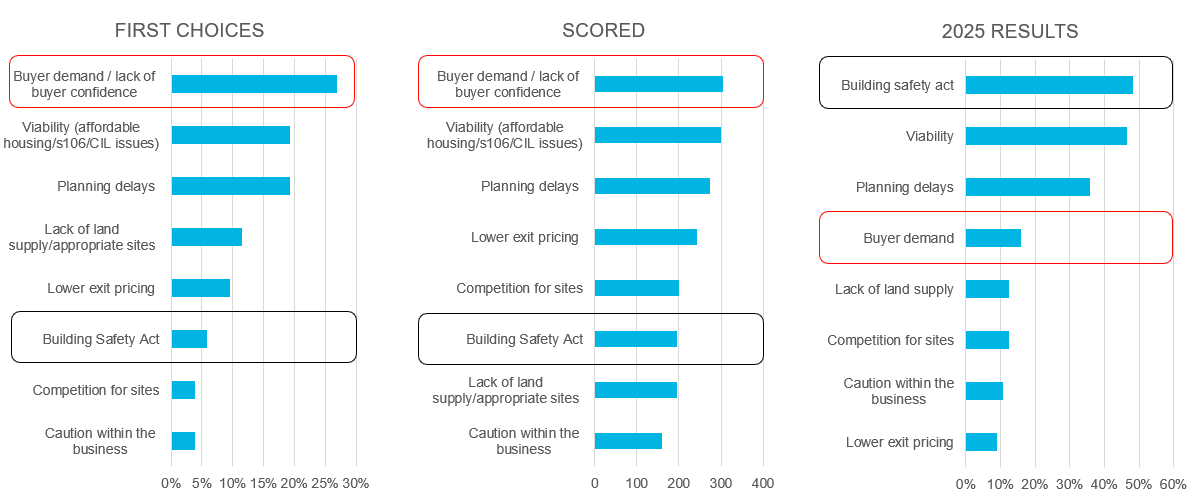
Part of the problem is the higher construction and debt costs of the past few years, but many have also pointed the finger at high costs for affordable housing and the Community Infrastructure Levy (CIL). Another major issue has been the slow progress of the Building Safety process introduced by the 2022 Building Safety Act, particularly the ‘Gateway 2’ step. In our 2025 survey, 48% of people attributed delays to this process, with viability close behind at 46%.

But this year’s results, covering 53 developers and investors, show a different pattern.
It’s the market, stupid

This time, we asked respondents to rank factors rather than simply choose which ones applied. ‘Buyer demand/lack of buyer confidence’ was the most popular first choice (27%), followed by viability (19%) and planning delays (also 19%).

The Building Safety Act was the first choice for only 6%. This suggests that attempts to speed up and streamline the process are working – or at least developers are confident they will, meaning the issue is sidelined for the time being.

When ‘scored’ (i.e. with the highest points given to first choices, and the lowest to last), the results are similar, though ‘lower exit pricing’ also becomes somewhat important.

Q: How would you rank the following as the biggest barriers to your business at the moment (from most significant to least significant)?

This all implies that developers are increasingly concerned that they won’t be able to sell what they’re building. Some of the reasons for this are clear – higher mortgage rates and lower investment activity, particularly from overseas. But there are other factors at play.

A shift towards lower rise

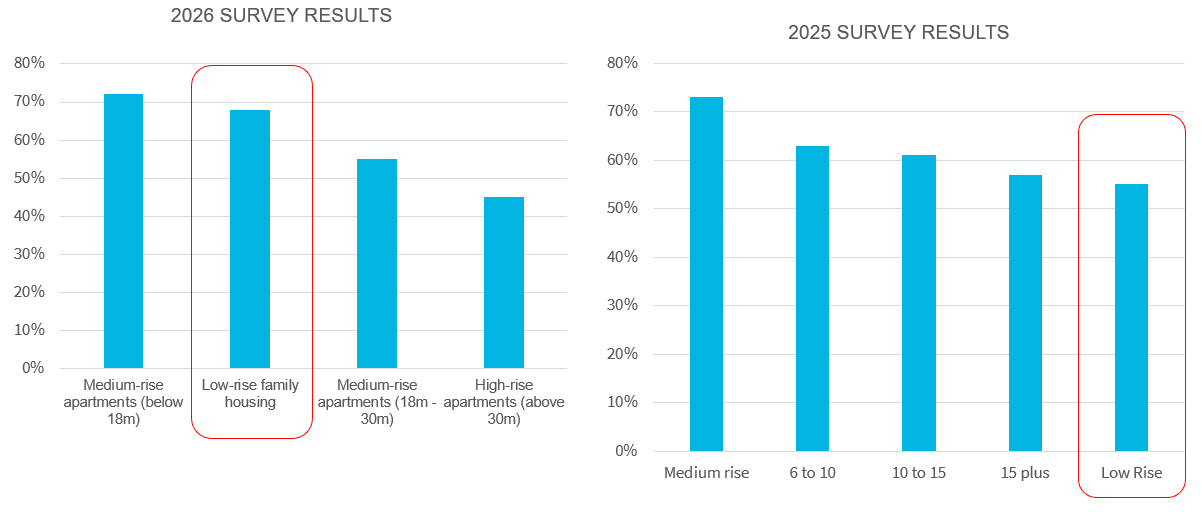
The shift towards medium-rise apartments (below 18m) was clear in the 2025 results but has become more apparent in our latest survey. These are now the most popular choice, sought after by 72% of respondents.

This isn’t just a building safety act issue. It may be that domestic buyers, who the market is increasingly reliant on, prefer flats in blocks of 6–8 storeys rather than towers. Developers are also avoiding locking up too much capital in large projects and prefer shorter-term flexibility.

Indeed, high-rise apartments are now the least popular option, selected by only 45%. The relative lack of planning consents for these towers (and more potential viability issues) could partly explain London’s growing delivery challenge.

More startling, though, has been the shift towards low-rise family housing. This was the least popular choice in 2025 (still high at 55%) but is now the second most selected at 68%. London specialists are less likely to choose this option (45%). This is probably due to land scarcity and reinforces the move towards simpler development.

The above demonstrates not only that viability is less problematic on greenfield suburban sites, but also that demand has shifted towards them. This may reflect that buyer groups – somewhat older, and more likely to be couples – struggle less with affordability, or that such locations are inherently less expensive. A higher distrust of leasehold properties and service charges is also a factor.

This explains London’s challenges. There are even fewer sites available for this type of development than for mid-rise apartment blocks.

Q: What form of housing are you looking to deliver?

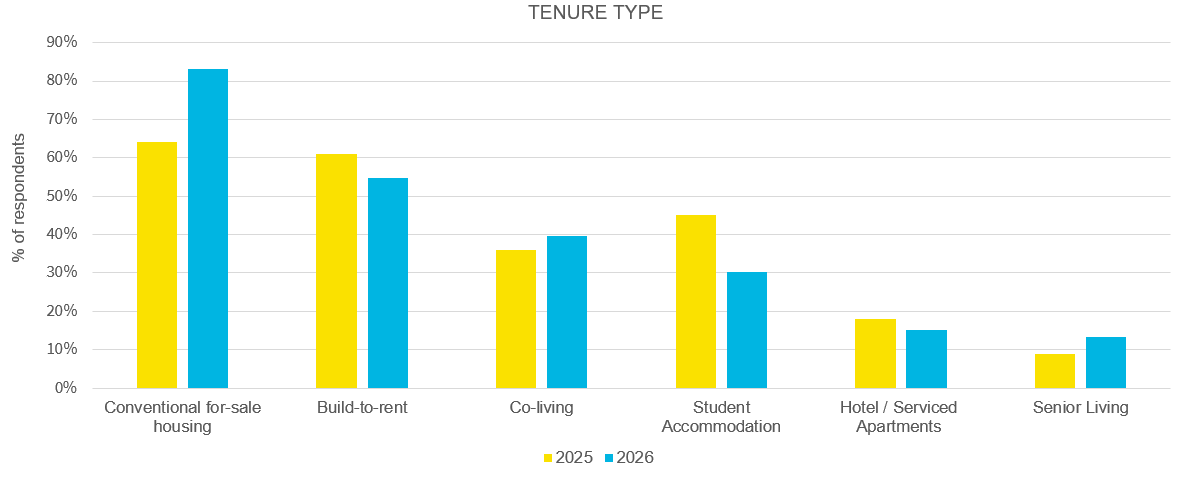
The shift also explains (partly) the increasing preference for ‘conventional for-sale housing’ and the move away from build-to-rent. The difference, however, in the latter is too small to be robust. More notable, and backed by market sentiment, is the decline in the intention to build Purpose-Built Student Accommodation (PBSA). This year it’s 30%, down from 45% in 2025.

Q: What type of housing are you looking to build?

The land market

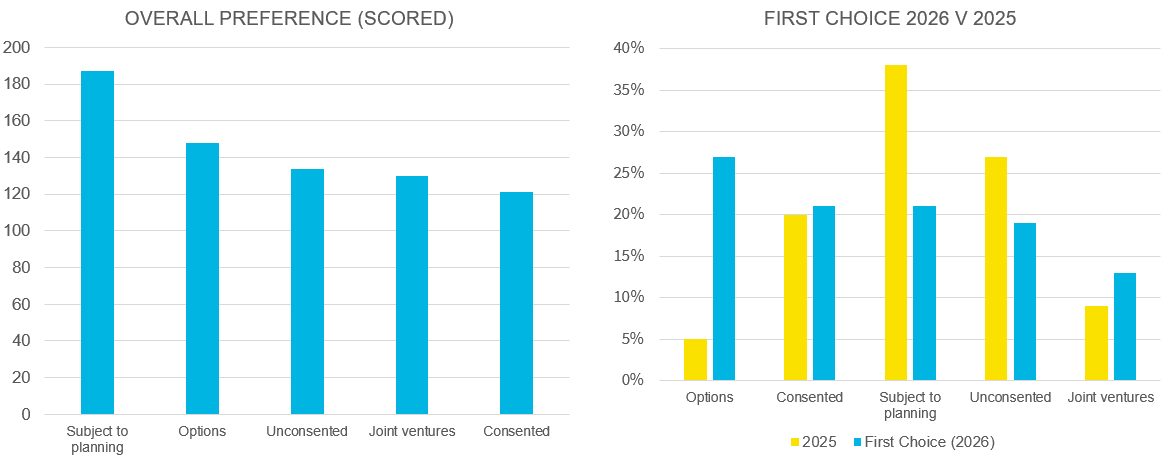
Given economic and planning uncertainties, it’s unsurprising that the market has shifted towards options as the first choice for accessing land. ‘Subject to planning’ remains the most popular overall, but has declined as a first choice compared to 2025. The popularity of unconsented land has shown the steepest fall. These all indicate a desire to preserve cash and keep sites moving, while the rise of option in particular, reflects both attitudes to risk and perhaps a growing focus on the green/grey belt.

Q: Can you rank the following deal structures in terms of preference (most preferred to least preferred)?

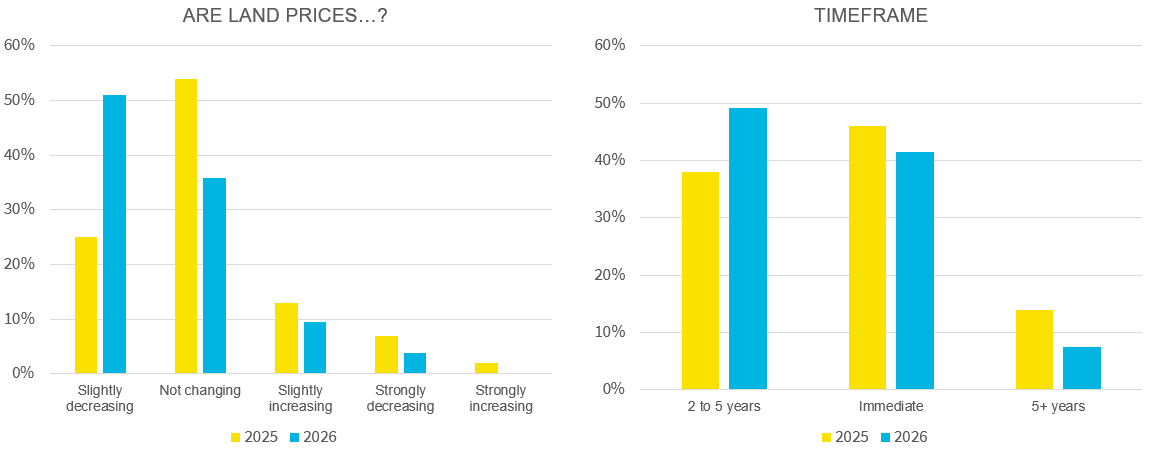
On a more positive note, most respondents (51%) report that land prices are slightly decreasing, reflecting greater realism among landowners . In 2025, over half (54%) reported flat pricing. Distress and the shift into ‘grey belt’ development may be other factors.

That’s important, as last year’s lack of adjustment made it difficult to acquire new land and bring it forward for development. This ‘new reality’ is another sign that the market – at the point of the survey at least – was past the worst and set to recover.

Q: From your point of view, land prices are… and, what time frame are you most concerned about/looking to fill in terms of your pipeline?

The GLA emergency measures

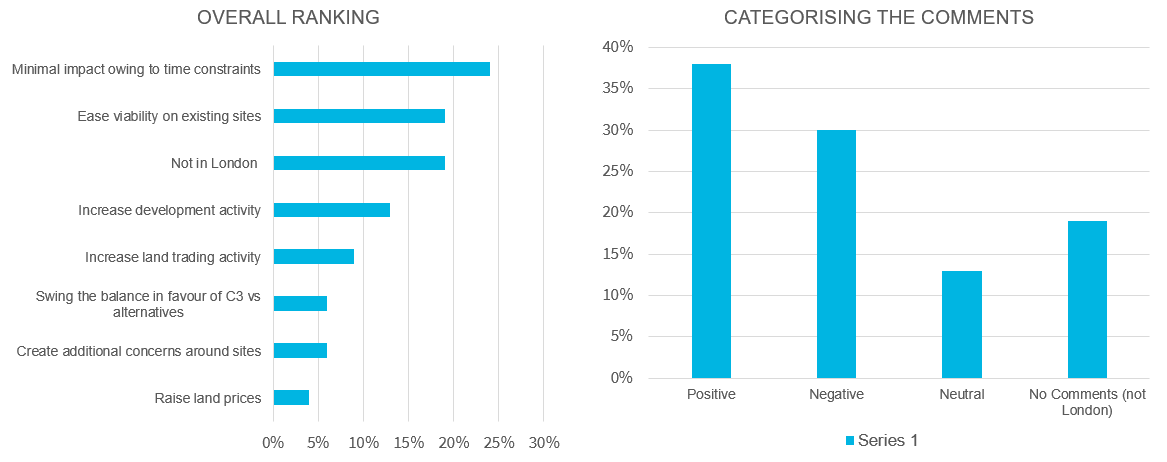
The emergency measures designed to speed up development and improve viability had been announced in broad brush before this survey was carried out. A narrow majority thought the changes were favourable, although there were severe concerns that the time constraints would prevent them from having any effect.

But despite this scepticism, many felt they would improve viability and increase development and trading activity.

Q: For London operations only – If the new fast track for planning is roughly in line with the consultation, what do you expect to occur?

The market in the respondents’ own words

The survey allowed respondents to provide comments on the land and development market. They acknowledged that conditions were “improving, but cautiously”, citing equity from institutions moving into the BTR market, and arguments that “the long game has considerable upside potential.”

Many saw renewed optimism in the re-entry of institutional capital into the market. Some even closed major deals over the past few months, providing an “escape route” and enabling them to raise capital for new products. These could be delivered to supply-starved markets in 2027 and 2028.

However, there were still major concerns around government attitudes and policies. They were seen as having shut down the off-plan investor market, which was key to making schemes viable and unlocking development.

As one respondent wrote:

“Both directly and through corrosive budgets and policy positioning, continued political meddling has significantly eroded the confidence of investors in the UK market.”

There were also calls to reintroduce “demand stimulus” to address the shortage of capable buyers. This ranged from a stamp duty holiday to the revival of Help to Buy.

One developer explained it clearly:

“London’s housing market is caught between short-term stress and medium-term scarcity. Developers are focused on clearing a backlog of unsold homes, leading to bulk and cashflow-driven sales in a slow-absorption environment. Construction activity remains subdued, some stalled schemes are only gradually restarting, and sales conditions are tough or very challenging.”

Yet beyond the immediate horizon, future supply is tightening, with many upcoming homes already committed, creating emerging scarcity.

They concluded:

“This leaves only well-capitalised developers, those able to absorb longer timelines, high costs and weak short-term sales, positioned to benefit when competition thins and market balance returns.”

In conclusion

Our survey was carried out before the beginning of the Iran War, which has obviously changed outlooks. However, the findings back up our previous assertion that the residential market had passed its worst point and was improving. Land prices are adapting, and developers are optimistic that the planning changes will have an impact. But there is also a recognition that this is a ‘long game’, and the recovery will be slow.

The findings also revealed that it’s no longer feasible to blame planning, viability and building safety for low delivery numbers. It’s mainly due to the lack of demand, at least for the kind of product that had typically been available in London. Help to Buy was a controversial policy, but the alternative may be a waiting game as prices adjust and wages rise.

The market is shifting towards medium-rise blocks in cities alongside a greater preference for family housing. Planning authorities will have to build this into their strategies, while noting that in London, at least, adjustments to expectations around CIL and affordable housing may be required for viability.
Lastly, the results encourage the government’s new towns agenda. Many are well located to provide a mix of medium-rise apartments and family homes in well-planned communities. Based on this survey, it appears this is where the market is moving.


The Montagu Evans Residential Land survey covered 53 developers and investors in London and the South East shows that market demand has now become the primary brake on delivery. The survey was conducted in January and February 2026, with analysis conducted in March 2026. Learn more about our research & insight services.

For more information, please visit our Residential webpage or contact Adrian Owen (Head of Residential), Jon Neale (Director of Research & Insight) or Richard Thomas (Land Agency Lead).

*This research has been prepared for general information purposes only. It does not constitute any investment, financial or other specialised advice or recommendations, and you should not, therefore, rely on its contents for such purposes. You should seek separate professional advice if required.

Share: