
DOWNLOAD THE REPORT
Summary
The UK property market entered 2026 with the expectation of lower inflation, cheaper debt and the beginnings of a recovery, but international events have disrupted that outlook. The conflict with Iran and closure of the Strait of Hormuz have kept energy costs elevated, while renewed inflation concerns, pressure on public finances and competition for capital from the AI investment boom have pushed gilt and borrowing costs higher.
This is putting upward pressure on property yields and pushing vendor and buyer expectations apart again, while placing further challenges on development viability. This explains both faltering investment volumes – Q2 was the lowest for almost three years and the stubbornly low level of housing starts, especially in expensive markets such as London.
However, economic growth has proved more resilient than feared and is driving strong rental growth in selected parts of the market. With capital growth increasingly uncertain, rental growth is becoming the key driver of investment decisions.
Three themes are increasingly shaping market dynamics. Assets that are scarce, suit both human and economic fundamentals, and/or chime with technology-driven structural change seem best placed to benefit from rental growth (and longer-term capital appreciation).
Residential is the clearest example. Despite weak recent returns and subdued rental growth, investment volumes have remained resilient as institutions consider long-term trends: a chronic shortage of homes, reduced landlord supply and a renewed imbalance between rental demand and new construction. Further forward-funding activity could even help support development, particularly as rental pressures look set to re-emerge.
The other bright spot is Central London offices, where the market continues to benefit from a shortage of prime space and strong demand from AI, technology and financial occupiers, supporting strong rental growth in both the City and West End.
Industrial investment has slowed but leasing demand and reduced development point to firmer fundamentals ahead. Retail is producing comparatively strong returns despite limited transactional activity, while hotels remain relatively buoyant.
Overall, the market is no longer one in which broad yield compression can be relied upon to lift all assets. Performance will depend increasingly on income and rental growth and on forensically identifying the sectors, locations and buildings where supply is genuinely constrained and demand is structurally durable.
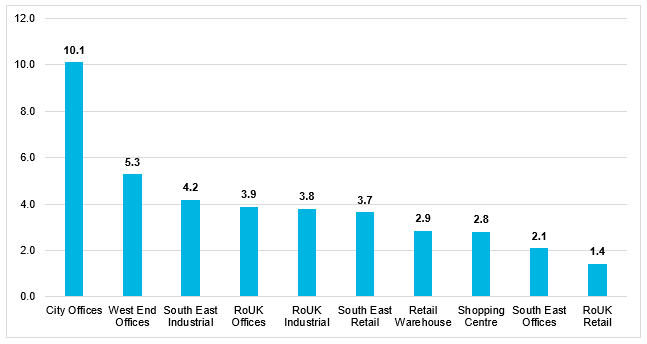
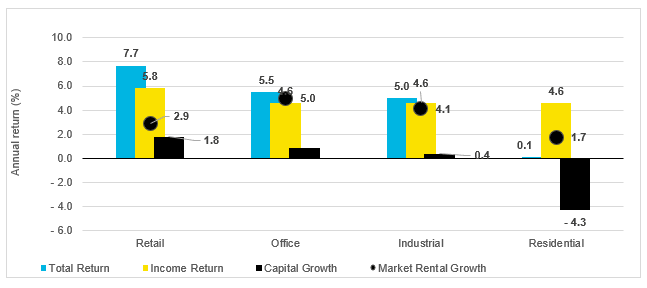
Rental growth by segment, year to q2 2026
Source: MSCI
SUMMER STASIS
As of July, Britain has a new Prime Minister with a new set of priorities that revolve around devolution (and Manchester in particular), but for the time being at least, property markets are being buffeted by international rather than domestic events.
The changes in sentiment over the past few months have been profound – mostly still linked to the US’’s decision to attack Iran in February.
At the beginning of the year, with inflation moderating and the economic outlook improving, the market looked set for a brighter period: lower risk-free rates and debt costs, and stronger demand. The Iran war and the closure of the Strait of Hormuz apart that optimism, replacing it initially with fear – that inflation would spike, that the economy would tank, and with them the property market.
This was replaced by another wave of optimism in the late Spring or early Summer, when it looked as if there was a ‘deal’ on the table. Oil prices fell and bond yields began falling once again. Inflation, while edging a little higher, looked like the dog that didn’t bark.
Since then, the fear and optimism have been replaced by something else: resignation. It’s become clear that the war was in fact nowhere near a conclusion. With that, the idea that global energy markets are going to return to normality anytime soon seems increasingly far-fetched. Oil and gas prices look set to remain elevated for some time, and there are risks of a further spike.
There are three key reasons why energy costs, while significantly higher than at the start of the year, have undershot initial forecasts. Firstly, the US – and some other countries – have dug deep into their strategic reserves of crude oil. Secondly, China, the second largest consumer, effectively withdrew from the market. Finally, other sources of oil and gas have ‘stepped up’.
Thankfully, this final point remains entirely valid. But on the other two – the US is beginning to reach the limits of its reserves, whereas China now appears to be buying oil again. Combined with the realisation that this war could go on for quite a while, and Ukraine’s attacks on Russian refineries, this creates quite an alarming situation.
Nevertheless, many energy analysts had expected a crisis well before now. It is entirely possible they could be wrong again.
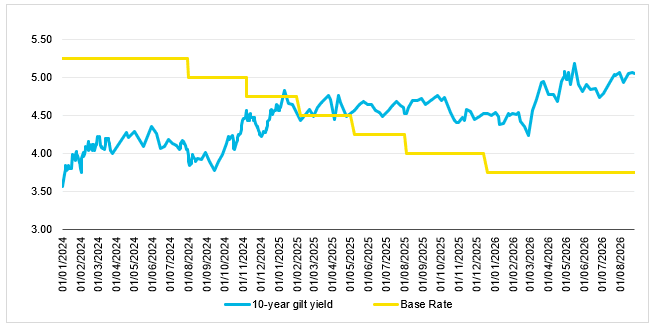
But the implications are really starting to feed through into higher inflation in the US and the UK, partly explaining why gilt yields have edged up. The 10-year yield stood at just over 5% at the time of writing, around 30bps higher than late June.
10-year gilts and base rates
Source: MarketWatch
There are other drivers, though. Concerns around government finances remain a strong undercurrent. A major milestone in the UK will be the October Budget when Chancellor of the Exchequer John Healey will have to set out his plans.
The UK has remained more resilient than feared – GDP growth came in at 0.6% in Q1 and 0.4% in Q2. Leading indicators have remained slightly positive, while retail sales growth has been strong. There are even signs of productivity growth. These are genuine signs for optimism – and indeed, if rates were lower, the economy might be performing rather well.
However, any wriggle room has been cancelled out by wider concerns over inflation, the higher cost of debt, and the longer-term concern that lower immigration will lead to weaker growth in tax receipts.
Healey has a difficult balance to strike between the instincts of backbenchers, the need to support business to drive growth, and the demand for higher military spending.
Increasingly, though, it seems that the upward shift in yields is driven not just by inflation or spendthrift governments, but the AI boom too. The demands of the ‘hyperscalers’ for funding – including debt and corporate bonds – is providing a huge supply of alternative investment options. This is reducing the demand for government debt, and with it the price, pushing yields upwards.
Needless to say, this is not great news for property (unless you own land suitable for a data centre). Real estate yields will at best be stable, and there may even be upward pressure if the trends outlined above intensify.
This means that real estate returns overall will remain relatively unattractive compared to other sectors unless pricing shifts radically. It also means that the difference between vendor expectations and buyer aspirations will potentially widen, and deals falter again. Debt rates will remain high, challenging development viability and keeping the mortgage market subdued.
So far, so bleak.
But there are some features that might help to provide some optimism to at least some market participants, either now or in the future. A lot of these rely on understanding the underlying fundamentals or longer-term trends, rather than simply relying on capital growth (as was the case for the 2010s).
THE NEW MARKET DRIVERS
The first is that scarcity is a key part of today’s property market. There is simply not enough product meeting the needs of occupiers in the right locations, from prime offices to data centres. If you are in possession of such a building, or have the capability to develop one, then the very strong rental growth produced by the underlying supply/demand imbalance will help to counteract any yield decompression. The key thing is identifying where these shortages and scarcities exist – or will exist.
The second is that the market has become more driven by human and economic fundamentals.That is partly which niches and geographies, or stock, will produce rental growth, the only saviour in this difficult market. But the current market, with scarcity the watchword, is ultimately about what humans fundamentally need – security, warmth, food and shelter. And, tech aside, these appear to have become the drivers of today’s marketplace.
The boom in defence spending will provide support for the industrial & distribution sector, while the need for energy security will drive the growth of renewables and battery storage. Concerns over logistics, including but not limited to food, will drive more demand for sheds as companies extend their inventory buffers.
The final need is perhaps the most influential for the market as a whole. Residential, in the UK at least, has been in a state of severe shortage for the past few decades, to the huge benefit of developers and agents. But the problem for them now is also scarcity: a lack of buyers, particularly at the prices they planned to sell stock at, driven in turn by a more restrictive mortgage market. But, as I mention below, there are signs that residential rents – flat for a couple of years in most places – are on the verge of another upward shift.
The final one is the most familiar from these sorts of crystal-ball gazing sessions; technology and structural change. The huge, unprecedented scale of AI funding is driving the boom in data centre land and construction – even if suitable sites are constrained by energy scarcity (that word again). And London’s office market is being supported by a wave of large, AI-related deals, centred on the triangle between Fitzrovia, King’s Cross and Clerkenwell. This demand is hitting against the aforementioned scarcity and driving rents upwards.
The irony is that It is AI which could change this three-pronged scenario, or rather a dramatic change in AI investment. Many investors are increasingly worried about the sheer scale of funding involved, and whether the companies involved will deliver on their promise of huge returns.
Few doubt now that it is a revolutionary technology – even if the exact impacts are debatable– but the key point is that the current market leaders may not be the ones to reap the rewards. Equally, investors are aware of the speed of change; a sudden breakthrough or innovation could make vast data centre networks, or indeed the technology itself, much less valuable.
If we are in a vast bubble, and it pops, then investors will scurry to safety in government debt, forcing down yields and making other investments, such as property, look more attractive again. Of course, there would be economic blowback too, with impacts on the leasing and residential markets.
Perhaps a more benign unwinding would come from Hormuz opening in some way or form. The greater capacity and supply the crisis has created in other world energy markets means that if the strait does reopen energy prices could fall quickly. This could push down inflation and bond yields, creating the ideal scenario for a market bounce back.
For the time being, though, there’s no sign of either of those things happening.
INVESTMENT MARKET OVERVIEW
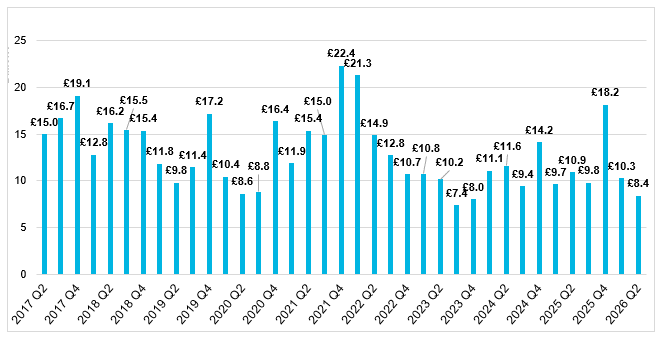
In terms of volume of property traded, the final quarter of 2025 was, at £18.2bn, by far the strongest since the post-pandemic boom at the end of 2021 and the beginning of 2022. This seemed very much like the beginning of the new cycle.
UK investment volumes
Source: MSCI Real Capital Analytics
But it was not to be repeated in Q1 2026 or indeed in Q2, which slumped to £10.3bn and £8.4bn respectively. Indeed, this latter figure meant it was the worst quarter in almost three years.
This is all hardly surprising, given the rapid and unexpected change in the underlying market and debt fundamentals. Investors had been assuming that capital values would be significantly higher in a few years’ time, a theory that collapsed alongside Hormuz shipping levels.
What is more remarkable is what has happened to specific sectors. Industrial and retail took the brunt of the fall – perhaps a reflection of where yields had been expected to compress the most. Offices were somewhat affected but remain relatively active compared to the past few quarters or the longer term, a result mostly of a continued vigour in Central London.
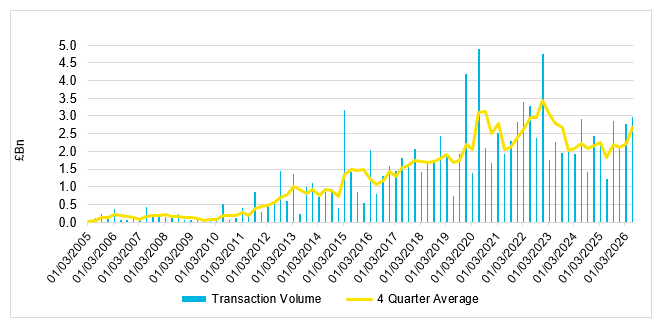
The real surprise is not here, though – it is in residential. Volumes here were 8% ahead of the last quarter, well over double the levels seen in Q2 2025, and 25% ahead of the 5-year average.
RESIDENTIAL RESURGENCE
RESIDENTIAL TRANSACTION VOLUMES
Source; MSCI Real Capital Analytics
This resurgence is a little counterintuitive. According to MSCI at least, performance has been atrocious. Total 12-month returns are at 0.1%, compared to 7.7% for retail and 5.5% for industrial, driven mostly by capital falls of 4.3%. And rental growth is dire too – just 1.3%, compared to 5.0% for offices.
MSCI QUARTERLY PROPERTY INDEX – Q2 2026
Source; MSCI
Yet investors are clearly keen. Over 2026 so far, for example:
- M&G and Korean NPS launched a UK joint venture aimed at multifamily
- Border to Coast (pooled Local Authority pension fund) forward funded a major project in Cambridge and acquired the Leaf Living portfolio (from Blackstone and IWG).
- The Pension Insurance Corporation acquired Ebb & Flow in Reading
- Principal Asset management bought two south west London multifamily assets.
This is officially a Q2 review, but since the end of June:
- Canadian investor Ridgeback acquired L&Q’s PRS platform Metro Living
- Greystar has bought all of Lend Lease’s Elephant Park
- Kennedy Wilson was selected to purchase Notting Hill Genesis’s Folio PRS portfolio.
Some of this is opportunistic; residential has been a difficult market recently, and many Registered Providers are in financial stress. Beneath the headlines there are a lot of bulk purchases from housebuilders who are unable to sell their product in more conventional ways. But it is undeniable that appetite is strong.
This is puzzling given that rental growth has been so unimpressive. Over the year to April 2026, according to Hometrack, average rents increased by just just 2.1% (below inflation). It is somewhat stronger away from London – 3.6% in the North West for example – although that is not where most of the deals have been happening.
So why are investors moving now?
Firstly, residential has been on their shopping list for years, partly because it’s the epitome of the scarcity theme mentioned earlier.
Even if current fundamentals disappoint, there is a severe shortage of homes in most developed countries, with the UK suffering more than most. This alone implies long-term growth. What’s more, residential behaves differently to commercial property or indeed many other investment classes, and for that reason alone can be desirable in an investment portfolio.
While starts have improved somewhat, they still remain well below targets, and activity is somewhat skewed to the North and Midlands. London, for example, has seen a slight improvement from a very low base, but it is much less marked.
Build to Rent construction has also slumped. Work started on just 5,500 BTR homes in Q1 2026, down from 20,000-30,000 in 2022 and 2023. (This slump is mostly driven by regional markets, which were booming a few years ago). Single Family Rental (SFR) has also fallen back, even if it represents a growing proportion of activity.
So, supply is scarce and getting scarcer (the low point in completions is yet to be reached). Meanwhile, first time buyers are facing very high mortgage rates, especially if they have smaller deposits. The assumption for many must be that rates will fall – so renting might be a good idea for the time being.
It isn’t just lack of construction that is constraining supply in the rental market specifically. Many smaller landlords have left the market over the past few years as a result of increased regulation, among other factors. This all adds up to a situation where demand looks set to outstrip supply once again.
And a look at the RICS residential survey suggests this is already happening. A net balance of 27% of surveyors report falling landlord instructions, while the balance expecting rental increases has risen from 20% to 29%. It might not be good news for those struggling with rental affordability, of course, but it may explain the sustained investor interest.
So while demand from ordinary buyers is unlikely to increase while rates are high, investment activity looks set to continue. This should percolate into more forward funding deals, which will help to shore up development numbers – especially when rental growth starts to become more evident.
OTHER SECTORS
While not being quite as resilient as residential, offices retained their attraction for investors in Q2 – although the figures are somewhat flattered by Barclays’ purchase of its own 1m sq ft HQ in Canary Wharf for £750m.
The deals list otherwise is headed by some trophy West End buildings – Deka’s purchase of 5-7 Carlton Gardens (Stirling Square) from Tristan & Greycoat for c. £200m, and Oval’s sale of 14 St George Street to a Singaporean client of BNP Real Estate for £173m. There was a reasonable level of activity in the City too, demonstrating the appetite for good quality and/or well-located stock.
It’s been clear for some time that occupier demand is geared around a small and dwindling supply of good-quality buildings, pushing up rents to unprecedented heights at the prime end of the market. Quoted prime rents in the City and West End now stand at £100psf and over £160psf respectively. MSCI shows rental growth in the City at 10% over the year to Q2, with the West End at 5.3%.
The RE:UK consensus forecasts have these two office markets outperforming everything else for rental growth – 6.9% over 2026 and 2027 in the West End, and 7.5% in the City.
And what is driving this occupier demand? The third theme mentioned above, technology and structural change. AI companies were once again at the forefront of lettings – Anthropic taking 160,000 sq ft at British Land and RLAM’s 1 Triton Square, Microsoft 97,000 sq ft at Hines’ 142-150 Wardour Street and OpenAI 77,000 sq ft at Nan Fung’s 34 York Way. All, once again, in that triangle between Soho/Fitzrovia, King’s Cross and Clerkenwell.
(Finance was also represented; the biggest deal of the quarter was insurer Lockton taking 233,000 sq ft at PineBridge’s 47-50 Mark Lane, while French investment bank Natixis agreed to lease 88,000 sq ft at 1 Queenhythe).
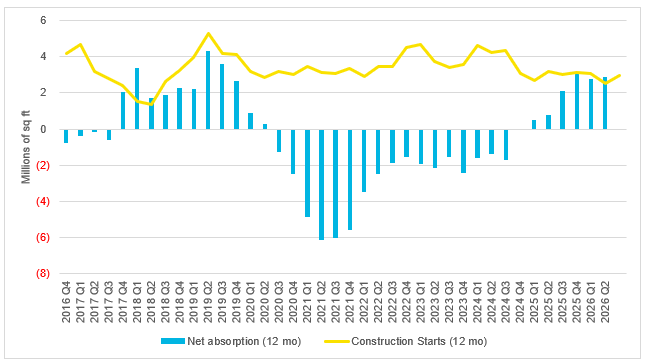
All in all, this means that net absorption has now been strongly positive for about five quarters. This alone would imply strong rental growth – backing up investors’ and analysts’ assumptions. With development falling back and construction costs challenging viability, the limited supply of new offices is unlikely to reverse for the foreseeable future.
Central London Offices
Source: Montagu Evans / CoStar
The investment market for industrial was somewhat more subdued, a result of the combination of a lack of stock and some yield compression earlier in the year, which might put some buyers off given the change in conditions. Indeed, the segment, which had the strongest returns until very recently, is now behind offices and retail in total returns over the past year, largely due to very weak capital growth (just 0.4%).
However, leasing has perked up after a few quiet quarters, with big box in the Midlands and mid box in the North West outperforming. We’ll be going into more depth on what’s happening in the industrial market later in the Autumn, but with construction slowing, it plays into the scarcity and basic fundamentals themes mentioned earlier.
Retail, meanwhile, is something of a puzzle. Total returns for the year to Q2 2026 (MSCI) were 7.7%, the highest of any segment. The income story has been there for a while, but capital growth is now at 1.8%, demonstrating that yields are coming in (easier here than elsewhere as they were higher).
So why the lack of activity? The returns are less polarised than a year ago, with all subsegments except department stores seeing 7%+ overall. The explanation must be a lack of appropriate stock – I suspect that beneath the surface of each category there is a lot of polarisation by location.
Finally, it’s worth mentioning the relative buoyancy of the hotel market; investment has also remained robust, and construction has not taken as much as a dive as other segments. This reflects – perhaps – a recovery in business travel and the growth of domestic city-break tourism.
Final thoughts
Scarcity, essential human needs and technological change are now shaping the UK property market more powerfully than expectations of broad-based capital growth. In this environment, rental growth will be the principal driver of performance. Identifying where it will emerge requires close attention to structural change and the enduring fundamentals of supply, demand and location.
If you have any questions about this briefing note, or any other aspect of the commercial or residential market, please contact jon.neale@montagu-evans.co.uk. We also carry out bespoke research for clients to inform strategy, guide policy or aid in individual sites or developments.
*This research has been prepared for general information purposes only. It does not constitute any investment, financial or other specialised advice or recommendations, and you should not, therefore, rely on its contents for such purposes. You should seek separate professional advice if required.