
download pdf
QUICK SUMMARY
- Despite the recent focus on the cities of the North of England, Central London remains critical for the growth of the UK economy. No other location has anything like the same concentration and scale of high-value employment and companies in critical sectors.
- The buoyancy of the Central London economy can be seen in demand for high-quality office space, which has remained much more resilient than in most national or international comparators.
- Since the pandemic, take-up has been far more in line with previous trends than in all other major UK cities other than Edinburgh. It has bounced back faster than Paris, its major European competitor, and on some measures appears more robust than New York.
- Forecasts point to continued strong growth in key sectors, with a particular focus on professional services and technology. Recently there has been strong demand from AI companies looking to tap into the capital’s talent pool. This all suggests that the flow of new requirements from occupiers will remain strong.
- The issue is increasingly the supply of appropriate space in the right location to meet this demand. This shortage is clearly from the rental growth over the past 12 months, which stands at 10.6% in the City and 5.3% in the West End according to MSCI – the highest of any UK property segment.
- Headline vacancy is relatively high by historic standards, but much of this available space is older or poorly located, while the viability of new development is being held back by higher costs, higher debt rates, investor caution and exit-yield uncertainty. The result will be continued market tightness, especially in the City, with rental growth remaining very strong.
- Unless financial conditions improve, London may struggle to deliver the space needed to support forecast employment growth, particularly if an AIdriven boom in demand continues. This could not only put upward pressure on office rents – it would also reduce the wider economic benefits.
- Larger occupiers have the option of taking a pre-let on a planned scheme, enabling it to continue – but this does not help those looking for space immediately, or smaller businesses that do not have the scale to trigger development decisions.
- In the short term, this is placing a greater emphasis on refurbishments and repositioning. Rental growth is concentrated in better quality stock, while there is a long tail of older, increasingly obsolete stock which is not suitable for modern requirements. This offers huge opportunities for developers and investors but planning and heritage policy may need to become more accommodating.
- The priority now is to create the conditions for viable investment in the right space in the right locations, so London can continue to support high-value employment growth. This will also necessitate enabling change of use in locations where office demand has weakened.
- The draft London Plan clearly emphasises the need for new office space, especially in the Central Activities Zone. However, it also discusses additional requirements, such as affordable workspace, which would further negatively impact viability.
INTRODUCTION
The argument that there has been too much focus on London at the expense of the rest of the country – particularly the North of England – has been in the spotlight over the past few months.
There is a strong argument that many cities outside London have underperformed, and that bringing their productivity up to European averages would make a huge difference to the UK economy. Manchester is, to some extent, already demonstrating that.
But in anything except the longest term, London’s growth is still by far the most important influence on the British economy. Central London, for example, has around 875,000 office-based jobs, compared to 191,000 in Birmingham and 186,000 in Manchester (the latter rises to 243,000 if we reasonably include Salford in the calculations). For many, the alternative to London is not Manchester but Paris or Amsterdam.
However, London’s success is being threatened not by a lack of economic growth and the resulting demand for offices – but by an inability of the development sector to deliver the required workspace. The statistics show that take-up in London’s office market has remained robust but also show that construction has slowed sharply. Higher costs and difficulties around financing and investor appetite are to blame.
In short, a lack of high-quality new workspace will increasingly become a barrier to London’s international competitiveness and ability to attract firms that will drive future growth in areas such as AI.
This not only reduces choice for the most high-profile entrants, but it also increases rental costs for many other companies who wish to expand or relocate. They could be stranded in inappropriate offices that reduce their productivity and curtail their expansion. The impacts go far beyond the individual businesses, affecting wider supply
chains, national economic growth and tax revenues.
The draft London Plan acknowledges the need for additional workspace in Central London but also suggests measures – such as affordable workspace requirements – that could further impact viability. More restrictive heritage policies around tall buildings would also be unhelpful. In the medium term, the policy context needs to support refurbishment – which appears to be increasingly where the market is leaning.
TAKE-UP AND FUTURE NEED
If we compare average take-up over the three years to Q1 2026, to the five years pre-pandemic, London has fallen back by just 1.3% compared to over 8% in Manchester and over 15% in most other major cities, with the professional services and tech sectors the main driving force.
Looking further afield, most reports suggest Paris take-up has been about 15-20% below pre-pandemic levels. Manhattan, meanwhile, has performed somewhat better but is still a few percentage points below the pre-2020 norm.
Net absorption measures the net increase in office space occupation, meaning it takes into account occupiers leaving as well as taking space. This has been positive in Central London since early 2025, with around 3m sq ft more space occupied at the end of Q2 compared to a year before. In particular there have been a high number of deals involving the fast-growing AI sector, as outlined below.
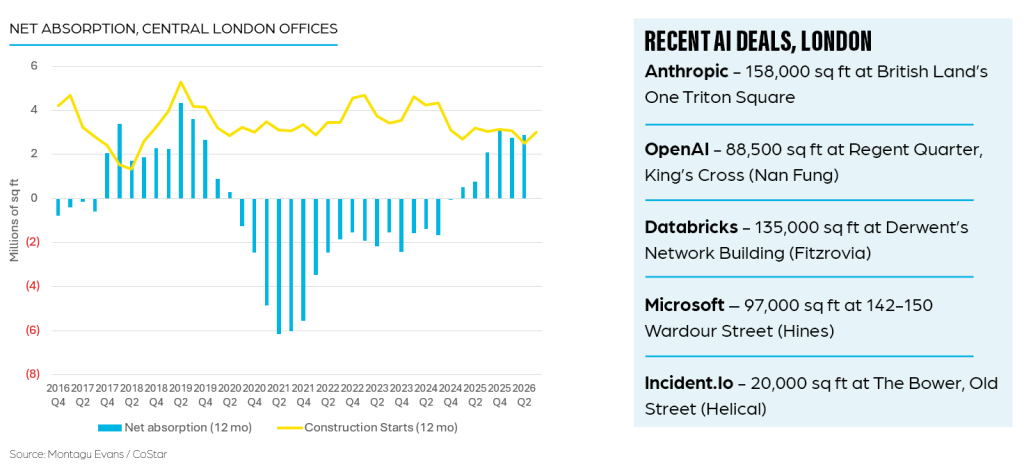
Meanwhile, forecasts of employment growth suggest that this strong demand for space will continue. Oxford Economics predicts that there will be 64,000 new jobs in the Information & Communication sector in Camden, Westminster and the City over the ten years to 2034, an increase of 24%. For office-based jobs overall, the figures are 190,000 or 16%.
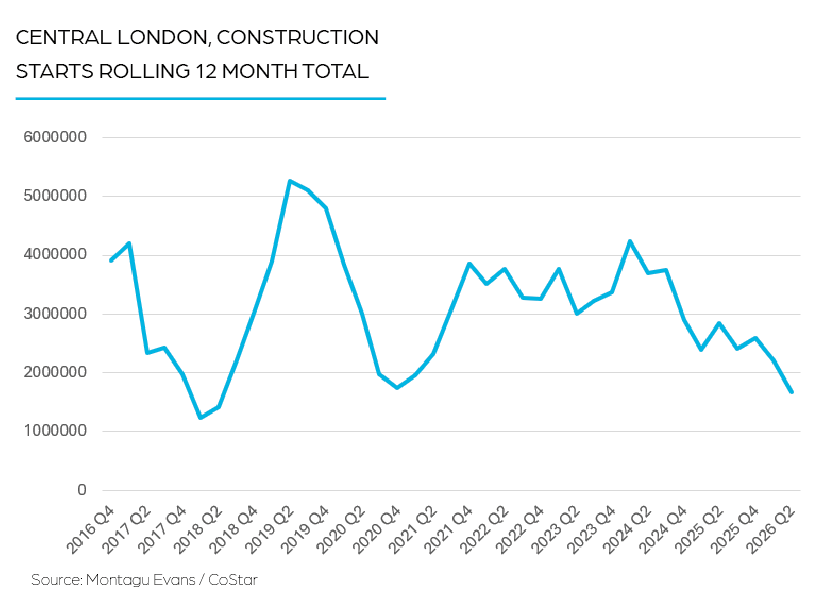
If we assume that each of these jobs requires 108 sq ft, that means that London needs at least 20.5m sq ft of additional office space over the next ten years, or 2.05m sq ft per annum. Over the year to Q2 2026, work started on just 1.67m sq ft of space.
This is not only significantly below the estimated need, but also well below the 10-year average of around 3m sq ft per annum.
The need figure is likely to be an underestimate, as new office space is not only required for growing firms and additional employees. It is also needed to allow existing occupiers to move from older or obsolete premises into modern space. It would hardly be acceptable if the only good-quality new space available were reserved for new companies or those expanding their footprint. This means that the real requirement is likely to be well above 2.05m sq ft per annum.
This point is also highlighted by looking at some of the nuances around the current market. While vacancy rates are reasonably high by historic standards – 11.2% in the City and 8.2% in the West End – rents are continuing to rise. But this apparent contradiction is easily explained.
The demand is for new or at least recently refurbished premises in the right location. But there is evidence that much of the vacant stock comprises older or poorly located offices. For example, according to CoStar, around 85% of currently available space in Central London is in buildings which are more than 10 years old.
In short, there is an increasing shortage of the sort of space that occupiers want, and this shortage looks set to worsen.
This is not just about quality of space; it is also about location. The past few years have seen a concentration of take-up around the central Elizabeth line stations as well as near major London termini such as King’s Cross/St Pancras and London Bridge. While this has intensified rental growth here, it has also led to a reduction in demand in some other more peripheral submarkets, making office use less viable in some cases.
HAS THERE BEEN A DEVELOPMENT RESPONSE?
With rents rising so rapidly, and forecast to continue doing so, developers should be incentivised to build more.
And there is some slight evidence that this has happened over a longer time frame, with development starts some 3% over the 10-year average, not well below it as in some sectors and locations.
But since 2024, activity has begun falling back, with a noticeable drop over 2026 in particular. Over the past 12 months, work started on just 1.66m sq ft of space – well below the 2.05m required. This has occurred at exactly the same time as a strong increase in net absorption.
This is despite around 21m sq ft of office space either seeking consent or approved but unstarted, suggesting that the immediate constraint is not simply a lack of pipeline volumes.
The problem is that viable schemes are increasingly rare and developers have lost the appetite to take the risk and build, despite the positive fundamentals. There are several reasons why this is happening:
- According to the ONS, commercial construction costs have risen by 23% over the five years to March 2026. This alone has impacted viability, but it has been complicated by lower competitive tension in the market as fewer contractors respond to tenders as well as higher uncertainty over future costs.
- The demand for “plug and play” offices has put the issue of rising fit-out costs into focus – and in some cases the increases are higher than for more general construction.
- Additional ESG or section 106 requirements have further added to the cost of development.
- Development debt rates have also risen rapidly since the pandemic, putting further strain on viability.
- Investors have withdrawn somewhat from the office market with higher returns available in other asset classes. This has reduced the amount of capital for development both directly and indirectly – leaving developers concerned about who will buy what they build, and at what price.
- The volatile bond market has not only increased hurdle rates for development and investment, but it has also created greater uncertainty around exit yields.
- Some international investors remain sceptical about the office market. Many other markets have struggled over recent years, particularly in the US, while concerns over the impact of remote working on office demand have been replaced by the fear that AI will replace significant numbers of jobs, reducing overall need for space.
Over the past few years, robust demand for offices has met a limited supply of good quality, well-located stock, driving rents upwards. The process is likely to accelerated further given the recent drop in construction activity, leaving firms with few options other than substandard second-hand space or prelets
At some point, rental growth may be sufficient to restore viability for more schemes, but that process is likely to be gradual and will still depend on finance costs, exit yields and investor appetite.
Planning data from Glenigan indicates applications for 3.1m sq ft of office space were received in the City and Westminster over the year to Q2 2026, compared to 7.7m sq ft over the previous 12 months. This does not suggest that developers are planning to ramp up activity in the near term.
There has been an increase in the number of deals recently involving development sites, but it remains to be seen whether these will translate into construction starts, given the viability challenges.
In the meantime, there has been some evidence of an increase in investors buying stock that is well placed for refurbishment, even though costs are just as much of a salient point here. The advantage is that the capital commitments are lower, speed to market is higher and risks are somewhat reduced.
Refurbishing now would enable stock to be delivered more quickly into a stock-starved market, rather than risking a longer-term development play that could land in very different cyclical conditions.
But while refurbishment has a role in office provision, it does not entirely make up for the lack of state-of-the-art new space required by many companies.
WEST END AND CITY DIFFERENCES
The broad picture painted above is playing out quite differently in the two key Central London markets. Net absorption over the past year has been c. 448,000 sq ft in the City, compared to c. 228,000 sq ft in the West End.
In development terms, though, the situation reverses. Over the two years to the end of Q2 2026, there were 2.7m sq ft of starts in the West End, but just 1.8m sq ft in the City.
This is not a result of planning. Based on our database of office projects with over 5,000 sq ft of floorspace, the total of office projects applied for over the past three years in the City is over four times that in the West End.
According to CoStar, there are around 15.5m sq ft of offices either applied for or consented and unstarted in the City, compared to 5.8m in the West End.
So why is construction activity in the City so weak compared to both demand and consented sites?
Firstly, the City historically was driven by large investors seeking large lot sizes. These are precisely the sort of companies who have moved away from real estate generally (and offices specifically) and into areas such as infrastructure or corporate bonds.
For other investors, the lot sizes of the City are too big to digest.
But in the West End, the mix of investors is different and the projects smaller and more manageable. Family offices, other private investors, the great estates and so on are also more willing to press ‘go’ on development. It also helps that yields here, a result of its attraction as a wealth preservation destination, have remained significantly lower.
This may go some way to addressing the skew towards the City over the longer term, which has seen the West End become proportionally less important as an employment location. More accommodating planning policies could also help. But the City must surely remain the largest single source of larger, corporate office space.
This imbalance explains why rents have risen twice as fast in the City as in the West End over the past year and suggests the City may see the most significant squeeze on supply in the future.
CURRENT TRENDS AND CONCLUSIONS
At the beginning of the year, there was some evidence that core institutional money was returning to the market. If this had continued, it might have helped ease some of the supply shortages, but the upward turn in rates since the closure of the Strait of Hormuz has curtailed that trend.
It did demonstrate, however, that investors have increasingly noticed Central London’s strong fundamentals and once the financial backdrop improves,
volumes could increase quite dramatically.
Central London’s office market is therefore in an unusual position. Demand is not the problem: employment growth, leasing activity and prime rental performance all point to a market with strong underlying momentum – one that may accelerate given the recent interest of AI companies.
It is clear that developers are increasingly unable to respond, particularly for projects in the City, where the scale and dependence on institutional capital have made new starts more vulnerable to higher rates, construction costs and exit-yield uncertainty. In the medium term at least, the Central London market will be characterised by a scarcity of good quality new office space in the right location.
This matters beyond the property market. If London is to continue to do much of the heavy lifting for UK economic growth, it needs the physical capacity to accommodate the high-value jobs being forecast, particularly in more dynamic sectors.
It also means that planners need to avoid placing additional burdens on office developers. The draft London Plan rightly recognises the need for sufficient new workspace, but its emphasis on affordable workspace requirements could add further pressure to scheme viability. London’s ability to provide appropriate office space is also challenged if more restrictive policies on tall buildings are introduced.
In the short term, the most practical response may be less about waiting for a full-scale newbuild recovery and more about enabling more refurbishment and repositioning. This could include a focus on microlocations where there are particular concentrations of redundant stock.
More flexible planning and interpretations of heritage or sustainability requirements could help release more good quality space in the right locations into the market.
Furthermore, while office demand has intensified in certain locations – notably around terminal and Elizabeth Line stations – it has weakened in some other areas. Planning policy needs to incentivise and enable change of use where office uses are no longer viable.
But unless capital conditions improve or regulations become lighter, the likely outcome is a tighter market, continued upward pressure on prime rents and a growing gap between the space London’s economy needs and the space its development market is able to deliver.