17 February, 2026 · 8 min read

London Residential Market InsightBottoming Out: Positioning for Recovery

Share:

Executive summary

  • After years of record-low starts and collapsing activity, early signs indicate that the end of 2025 marked a genuine turning point in London’s housing market, with investor interest increasing and construction gaining pace.
  • Given delivery lags, completions in both BTS and multifamily BTR are set to fall sharply in 2027–28, tightening availability and pushing up rents, sales values and demand for sites.
  • With viability improving and this supply squeeze on the horizon, 2026 represents a rare window of opportunity for land acquisition and alternative-use housing strategies for institutional capital.

"HAVING REACHED THE BOTTOM OF THE LONDON RESIDENTIAL MARKET IN LATE 2025, THERE ARE FURTHER SIGNS THAT THE ‘PERFECT STORM’ THAT MADE VAST SWATHES OF PROJECTS UNVIABLE IS BEGINNING TO SUBSIDE." - Adrian Owen


Background

The London housing market has been in the doldrums for several years. Rob Perrins, Executive Chair of Berkeley Group, described last year as “…even worse than after the 2008 financial crash…”

On paper, house prices in the capital have fallen by 2% since their mid-2022 peak – although that translates to an 18% fall if adjusted for inflation. Meanwhile, rents rose by 3.7% per annum between October 2022 and 2025, but that translates to a slight real-terms fall.

Similarly, transaction volumes have never recovered the 120,000–160,000 ballpark they saw before the Global Financial Crisis. And while 80,000–100,000 became the new normal in the 2010s, they have since fallen to 60,000–80,000.

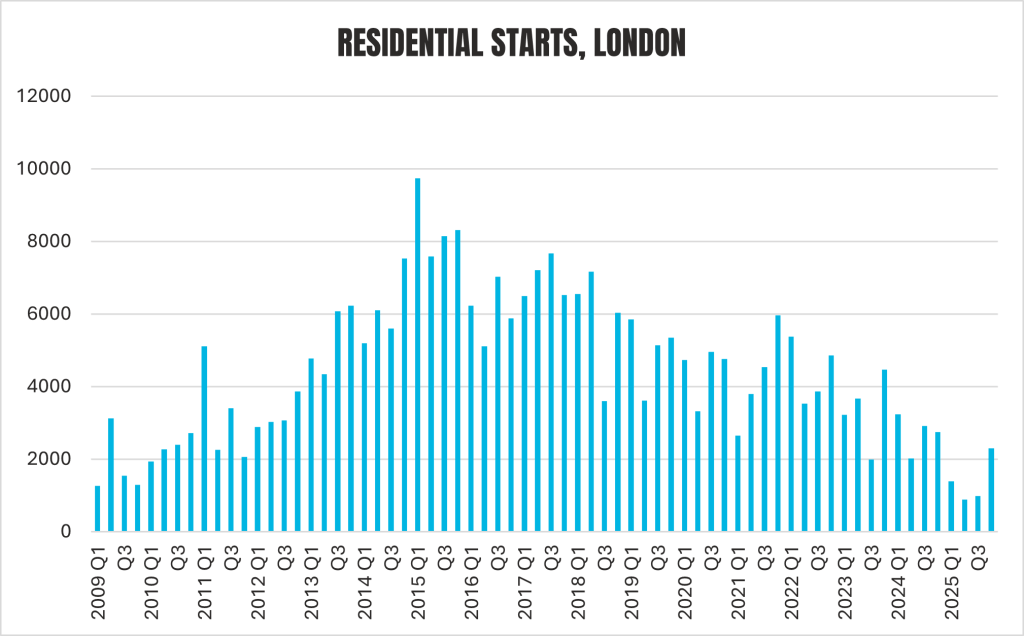
And most starkly of all, development has collapsed. There were just 2,940 starts in 2025, by far the lowest on record; even during 2009, the worst year of the financial crisis , London saw 14,140 starts. To put this in perspective, the year with the next lowest starts was 2024, with 6,600. So, the last two years have been a disaster for housing development in our nation’s capital.

Completions, for obvious reasons, have taken longer to fall back, but 2025’s 11,590 still represents the lowest on record, although by a much slimmer margin.
Source: Molior

Early signs of improving viability emerge

However, there are signs that from this very low base, the situation is starting to improve. The figures quoted above from Central Government show an extremely modest increase in starts in London, from 4,020 in Q2 to 4,220 in Q3. But the much timelier data produced by specialist provider Molior shows starts increasing from just 870 in Q2 and 986 in Q3 to 2,294 in Q4 – the highest in a year.

Adrian Owen, Partner & Head of Residential at Montagu Evans, believes: “I have seen a number of cycles in my 30-year career but nothing as bad as this dire crisis in London but as a firm with a strong pedigree in the housing sector, we believe that we are at the bottom. There are further signs that the ‘perfect storm’ that made vast swathes of projects unviable is beginning to subside. While construction costs remain elevated, debt costs are falling, albeit slowly. But more importantly, as part of its wider focus on increasing housing delivery, the government is beginning to pay attention to the dire situation in London, so much worse than in the wider country, amid wider fears of a loss of industry capacity that could take years to repair.”

London has been particularly struggling for four main reasons:

  • New towns iconThe majority of delivery is as apartments in taller blocks. These are affected by the delays at Gateway 2 of the Building Safety Act
  • The cumulative burden of affordable housing requirements. Community Infrastructure Levy and Section 106 is more significant, particularly given the correction in London house prices
  • The upfront costs of such apartments are high. This means they are harder to fund in today’s financial conditions.
  • New towns iconRestrictive mortgage markets and a significant increase in the base interest rate. These have have stalled sales from domestic purchasers. Continuous political ‘tinkering’ on taxation of overseas investors has turned off the demand side tap.

The first two points are being addressed by recent ‘fast track’ reforms to improve viability. Montagu Evans’ calculations indicate that the combination of higher grants, lower affordable housing requirements and CIL reliefs will have a significant impact, particularly in lower-value locations.

Richard Thomas, Partner & Land Agency Lead at Montagu Evans, believes:

“The emergency measures will particularly support lower-value schemes to be delivered. They will, in many cases, over-deliver on the 20% affordable housing level where Registered Provider demand is sufficient. This is important as land in London can often have a viable alternative use, so the idea that land values will just drop is not realistic.

“The market is increasingly supportive of the BTR sector, but the improvement in viability only applies to traditional affordable, not Discounted Market Rent or London Living Rent. While the measures are a genuine step forward, to truly increase delivery, liquidity and viability need to move hand in hand.”

In other words, the government and the GLA need to make further steps to support the market in the upcoming London Plan revision.

However, the government’s proposed National Planning Policy Framework (NPPF) updates will also support the delivery of more and faster planning consents, with policies such as:

  • A clearer outline of what ‘grey belt’ is
  • A strengthening of the presumption in favour of development
  • Automatic consent for higher-density schemes near busy railway stations
  • The greater use of Local Development Orders – a form of localised zoning

And the market is already starting to respond. Will Edmonds, Partner & Residential Planning Lead at Montagu Evans, confirms that Q1 has seen a marked increase in planning activity:

“The Montagu Evans planning team are currently progressing applications capable of delivering over 100,000 new homes across the UK. There are now clear signs that the emerging national policy position and emergency measures are having the desired effect in stimulating developer interest in London on sites that have been stalled for some time. I hope the consultation responses delivered by the industry to the consultation documents are carefully considered and listened to to ensure this stimulus is not lost”

But the demand side remains problematic. According to Molior, there were just 8,398 sales of new build units in 2025, the lowest since 2010, and less than half the 10-year average. The 3,888 units complete and unsold are the highest on record.

"There are now clear signs that the emerging national policy position and emergency measures are having the desired effect in stimulating developer interest in London on sites that have been stalled for some time." - Will Edmonds


Why Q1 could mark a more meaningful market shift

Even against this subdued demand picture, the progress is significant. And it represents only one part of a much broader shift. There are three further reasons Q1 could mark a turning point.

1) Mortgage rates have eased considerably, and restrictions on affordability and LTVs are becoming looser

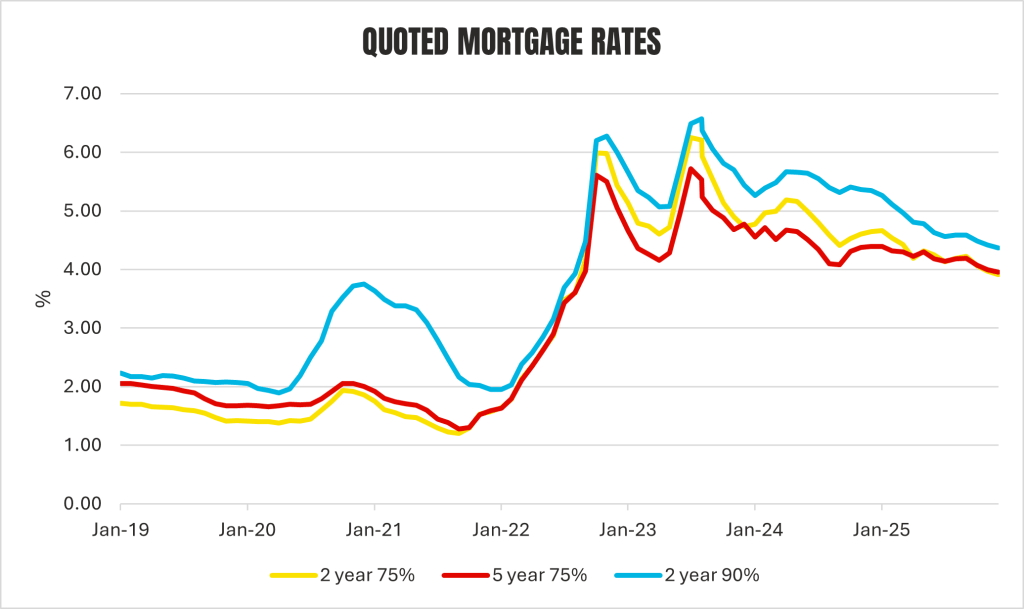
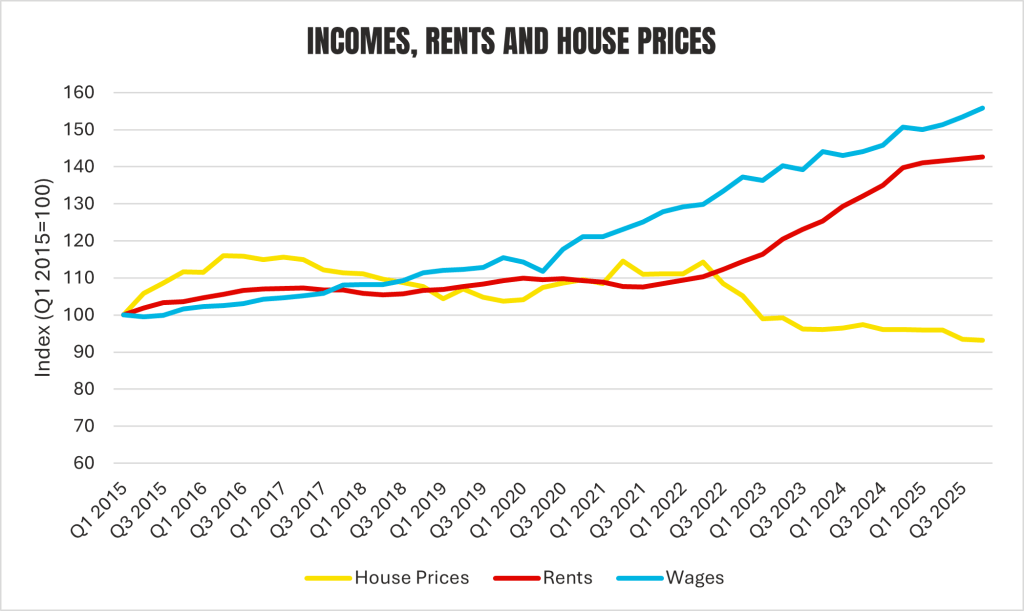
However, quoted mortgage rates are now at the lowest level since autumn 2022, with a 2-year fix at 90% LTV, a percentage point lower than a year ago. And while London house prices are 2% below the peak, wages (including incentives) are 23% higher than in 2022, the highest increase in any three-year period since the time series began in 2002.

Source: Bank of England

Source: Office for National Statistics

While this will not make buying in the capital suddenly affordable for a broad swathe of the population, given where pricing is compared to salaries, it will help on the margins, especially if rates continue to fall and it becomes easier to get a mortgage with a lower deposit.

The government has made mortgage lending to those with smaller deposits easier – the scrapping of the ‘stress test’ and the reduction of the cap on higher-LTV loans, as well as the FCA’s decision to allow rental history as a measure of affordability. However, many believe that additional buyer support is needed to spark a housing recovery, but this is seen as a political ‘hot potato.’

2) Rental conditions, while still poor, are beginning to show signs of an imbalance

According to the RICS residential survey, tenant demand is at a low ebb, the lowest since the pandemic. But new landlord instructions have been in deeper negative territory for far longer,

There is evidence that many smaller-scale landlords in London are selling up; according to Zoopla, 31% of homes for sale in London at present are former rentals.

This suggests that the overall supply/demand situation is becoming more landlord-favourable, which will push up rents in the medium term. Meanwhile, with real rental growth still in negative territory, renting is becoming more affordable, supporting demand.

This imbalance will not be evident immediately, but investors are beginning to note the growing undersupply of rental accommodation in the capital.

3) Investment in the BTR sector has turned a corner

Investors have recently become much more positive about real estate generally, with fundraising increasing by 21% in 2025 – the first increase since 2021.

Recent surveys have also shown that a significant chunk of investors expect to expand their allocations to real estate over the next year to two years. Residential is consistently listed as a target sector, ranked just behind data centres.

Jonny Stevenson, Partner & Residential Capital Markets Lead at Montagu Evans, says:

“All indicators now point to late 2025 early 2026 marking the bottom of the UK BTR market. Increasing investment volumes, capital evidently raised, improving debt conditions and renewed clarity around planning and regulation are drawing capital back into the sector just as interest rates begin to fall. With sentiment turning and fundamentals strengthening, the market appears to be pivoting from correction into the first phase of recovery.”

London has lagged slightly due to higher debt costs and viability issues, but these are now beginning to subside. The recent disposal of Notting Hill Genesis’ PRS arm has sparked significant interest, while earlier in January, Principal Asset Management acquired two MFR investments in South West London for more than £100m.

At the end of last year, M&G announced a joint venture with the Korean pension fund NPS to invest up to £1bn in UK multifamily housing, with a view to developing more than 3,000 homes in London and the major regional cities.

In another sign of the improving market, albeit outside London, one of the UK’s largest LGPS, Border to Coast Partnership, has agreed to a £70m forward-funding deal for an SFR project in Cambridge. This is important as it demonstrates the increasing role that could be played by these larger aggregate LGPS pools.

Moreover, many developers are looking to dispose of completed and soon-to-be-completed stock so they can fund new phases in existing and acquire new schemes, hoping to deliver into a stock-starved market as sentiment improves. While starts have risen slightly in recent months, they still remain at very low levels by historical standards. This is particularly true for BTR starts, where there were just 696 in 2026.

Given that the rental stock has reduced considerably owing to wider pressures, this should create a shortage of property to rent in 2027 and beyond. London’s population continues to grow, and there is now a substantial backlog of households seeking accommodation, all intensified by the recent lack of new affordable housing delivery.

"With sentiment turning and fundamentals strengthening, the market appears to be pivoting from correction into the first phase of recovery." - Jonny Stevenson

2026: A window of opportunity

Together, all this explains why the end of last year was a turning point in the market. From now on, conditions will improve. This will be gradual in 2026, as confidence returns to the market, acquisitions and funding deals are struck, and construction starts slowly to rise. While there are risks, both economic and geopolitical, that sort of pace looks set to intensify in 2027.

This is precisely why 2026 could be a strategically important moment for institutional investors to secure land and pursue alternative-use housing opportunities.


Montagu Evans’ Residential:Connected Team brings together more than 80 individuals across 14 specialist areas within the housing lifecycle who work across the UK to support client landowners, investors, developers and local authorities to capitalise on emerging opportunities, mitigate key challenges, unlock value through expert insight and foster successful partnerships.

For more information, please visit our Residential webpage or contact Adrian Owen (Head of Residential), Jon Neale (Head of Research & Insight), Will Edmonds (Residential Planning Lead), Jonny Stevenson (Residential Capital Markets Lead) or Richard Thomas (Land Agency Lead).

Share: