
8 October, 2026
THE EVOLUTION OF TOWNSCAPE: ACCOMMODATING GROWTH, ASSESSING SIGNIFICANCE AND COMMUNICATING CHANGE
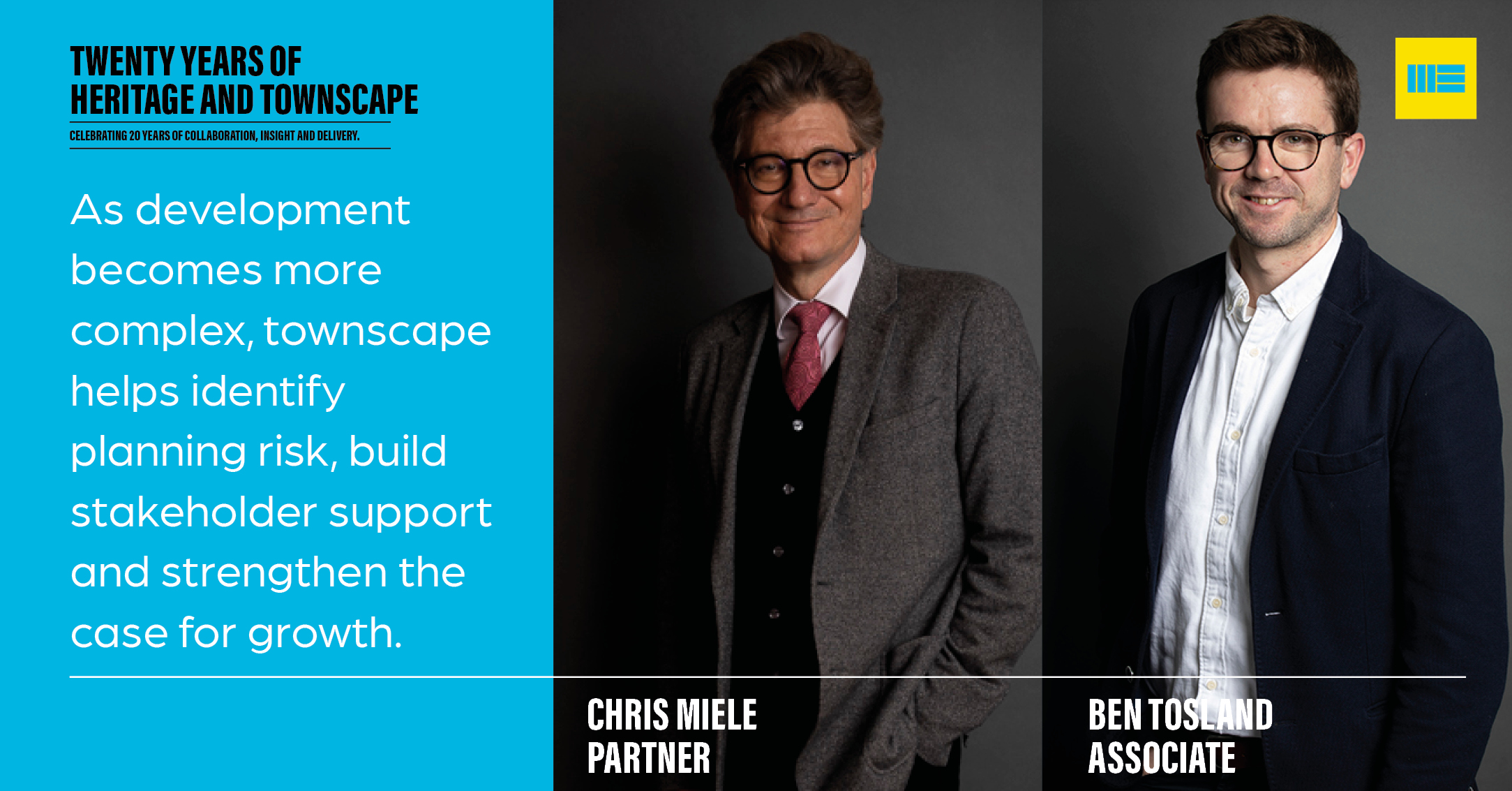
by Chris Miele, Ben Tosland
Learn more
23 July, 2026 · 5 min read
The Mayor’s draft London Plan marks a notable shift in how growth is expected to be delivered across London over the next two decades.
A central theme running through the consultation draft is a move beyond simply managing growth towards actively shaping it. Across housing, employment land, tall buildings, the Central Activities Zone (CAZ) and even parts of the Green Belt, the Plan acknowledges that London’s housing and economic ambitions cannot be achieved by preserving existing patterns of development alone.
For investors, developers, landowners and local authorities, the draft Plan provides a clear indication of the priorities likely to influence planning policy and investment decisions in the years ahead.
Here are ten strategic themes that stood out to Montagu Evans.
This is one of the most significant changes in the draft Plan. Previous plans focused largely on accommodating growth where it emerged. This draft London Plan takes a more interventionist approach, setting a spatial strategy for London and identifying strategic growth corridors, broad locations for growth, transport-led intensification opportunities and strategic tall building clusters.
Across housing, employment land, tall buildings, the CAZ and Green Belt policy, the Plan reflects a clear view that change is required if London is to meet housing and economic objectives set by the Plan; although whether these objective go far enough is open to question in terms of ensuring full needs are met. For the first time it targets land across the city, identifying where growth should take place and introducing a significant shift in the approach to density, height and land use.
The Plan represents a clear shift from managing growth to actively directing it which is to be applauded.
The introduction of a London-wide Optimisation Framework, which sets minimum density and indicative height expectations, as well as support for mid-rise development and a strategic approach to tall buildings all point to a strategy focused on unlocking additional capacity within London’s existing urban area.
Similarly, much of the employment growth in more traditional sectors such as industry and logistics is envisaged to come from redevelopment and intensification of existing sites rather than new allocations.
The implication is that much of London’s future growth will need to come from increasing capacity within existing urban areas, though the Plan acknowledges that this approach alone will be insufficient.
The Plan recognises that ambition alone will not deliver homes.
It introduces location-based affordable housing thresholds, revised approaches to public and industrial land, and continues to require viability testing and review mechanisms in certain circumstances. Taken together, these policies suggest a more nuanced approach than in previous iterations.
Housing targets have also been updated to reflect perceived local development capacity, with the draft Plan now identifying, where relevant, separate brownfield and greenfield housing figures for individual boroughs.
One of the most politically significant changes is the Plan’s approach to Green Belt land.
For the first time, the Mayor has identified broad locations for growth and acknowledged that selected Green Belt locations may need to contribute towards London’s housing and economic needs.
This is not a wholesale release of Green Belt land, but it does represent a notable policy shift.
Green Belt policy is no longer defined solely by protection. The focus is on identifying locations where development can support wider housing and economic objectives.
One of the more surprising omissions from the Draft London Plan is the lack of an explicit target for office growth. Whilst housing delivery is measured against clear strategic targets, there is no equivalent ambition for office floorspace, jobs or productivity growth, despite Central London’s critical contribution to the UK’s economy and tax revenues.
The introduction of Core CAZ and Mixed CAZ designations could nevertheless have a major influence on development strategy, land values and investment decisions. Core CAZ prioritises the protection and growth of commercial floorspace, whereas Mixed CAZ creates greater opportunities for mixed-use and residential-led development.
The draft Plan also strengthens affordable workspace policy, placing greater emphasis on securing affordable workspace or contributions as part of major commercial development. The challenge will be ensuring this remains flexible and focused on economic outcomes, rather than becoming a rigid requirement that discourages investment and slows the renewal of ageing office stock.
Similarly, the draft Plan places greater emphasis on retrofit, building retention and embodied carbon. Encouragingly, it stops short of a retrofit-only approach and recognises that these decisions should be balanced against the wider benefits of economic growth, productivity, modernisation and long-term sustainability.
The draft Plan introduces a more prescriptive and strategic approach to taller buildings.
The draft Plan identifies 17 metropolitan tall building clusters for buildings over 100m and is explicit that mid-rise development (12m up to 30m) will need to be delivered across many more parts of London. Buildings above 30m are directed towards areas identified for growth with very good transport accessibility.
Heritage, design quality and townscape considerations remain important, but decisions on height are becoming more closely linked to transport accessibility, land optimisation and strategic growth objectives.
The draft Plan seeks to balance several competing priorities.
London wants to deliver more homes, intensify industrial land, support logistics growth and accommodate increasing demand for data centres.
Each of these uses requires land, and the supply of suitable sites is finite. Increasing pressure on utilities, both power and water, will also drive decision making with a continued focus on all new development being as sustainable as possible.
As these competing demands intensify, decisions about which uses should be prioritised will become increasingly important for both policymakers and the development industry.
The language surrounding London’s economy is more prominent than in previous plans.
The draft Plan describes the CAZ as the “powerhouse of the UK economy”, supports the delivery of net additional prime office floorspace and identifies several strategic growth locations around major transport hubs.
Economic growth and competitiveness are positioned more explicitly as planning objectives rather than simply outcomes of successful development.
For investors in and developers of commercial uses, that emphasis should be welcomed.
The draft London Plan recognises that there are opportunities for the adaptive reuse of heritage assets across London. The new heritage policy explicitly supports retrofit measures and encourages streamlined consent mechanisms that provide clarity and certainty about appropriate works to historic buildings.
The policy approach supports wider discussions about how underused historic buildings can contribute to housing delivery, regeneration and town centre renewal. For owners and investors, this creates greater scope to bring underutilised heritage assets back into productive use while supporting both regeneration and sustainability objectives.
One of the clearest themes running through the document is an emphasis on delivery.
The draft Plan reflects greater attention to viability, infrastructure capacity and investment confidence. Housing targets have been moderated, infrastructure constraints are given greater prominence, and several policies have been adjusted to reflect market conditions.
The emphasis is shifting towards delivery, viability and implementation rather than policy ambition alone.
Final thoughts
While the draft London Plan remains subject to consultation, there can be little doubt about its strategic direction. The Mayor is proposing a growth-oriented planning framework that seeks to unlock development capacity across London through intensification, the optimisation of underutilised land, new broad locations for growth, growth corridors and clusters, and a more positive approach to reviewing Green Belt land where it can support sustainable growth.
The result is a draft Plan that is more supportive of large-scale development than its predecessor. For developers, investors and landowners, this creates the prospect of a broader pipeline of opportunities, both within and beyond traditional growth locations, as London seeks to accommodate substantial housing and employment growth over the coming decades.
Although the detail will continue to evolve, the message is clear: delivering the growth that London needs will require more intensive development than we’ve seen in recent years, and the draft Plan goes someway to providing a policy framework prepared to support it. Whether it goes far enough is very much open to interpretation and we would be delighted to speak with you to share on views on this and to support representations you will likely be wanting to make at the important juncture in policy formulation.
Related insights
8 October, 2026
by Chris Miele, Ben Tosland
Learn more

28 September, 2026
by Kate Falconer Hall, Emma Lawrence
Learn more

16 September, 2026
by Tim Miles
Learn more
19 August, 2026
by Craig Blatchford
Learn more